


Send Message
Privacy statement: Your privacy is very important to Us. Our company promises not to disclose your personal information to any external company with out your explicit permission.

 Product Categories
In modern power systems, energy management solutions, and industrial automation equipment, accurate current measurement is essential for safe operation and efficient energy management.
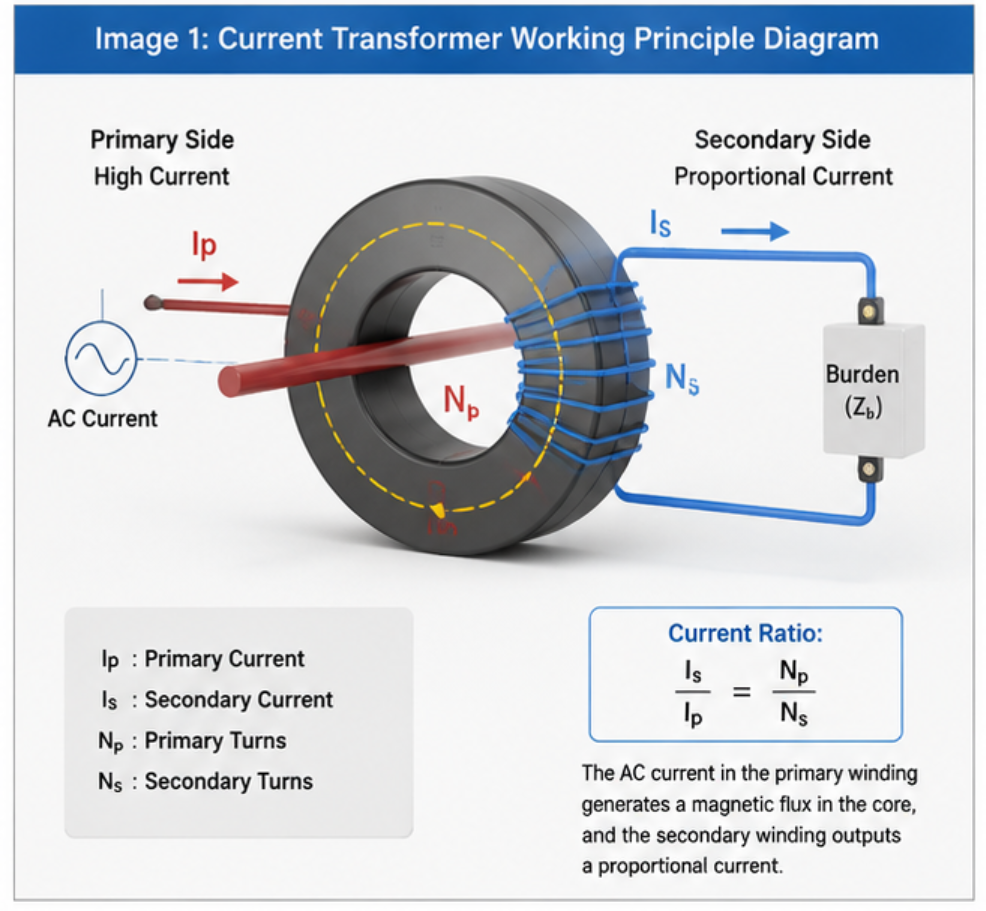
However, in high-current applications, directly connecting measuring devices to the power circuit can introduce safety risks and increase system design and maintenance complexity. Therefore, engineers usually use a current transformer (CT), which applies the principle of electromagnetic induction to generate a current signal in the secondary winding that is proportional to the primary current.
This allows measuring devices to achieve safe and accurate current measurement, monitoring, and protection under electrical isolation conditions.
Current Transformers are widely used in smart meters, energy monitoring systems, industrial control equipment, solar power systems, electric vehicle charging equipment, and power protection systems.
In this article, we will explain what a current Transformer is, how a current transformer works, different types of CTs, and common current transformer applications. For a deeper understanding of CT operating principles, you can also read our detailed guide on how a current transformer works.
A current transformer (CT) is a magnetic component that uses electromagnetic induction to measure electrical current.
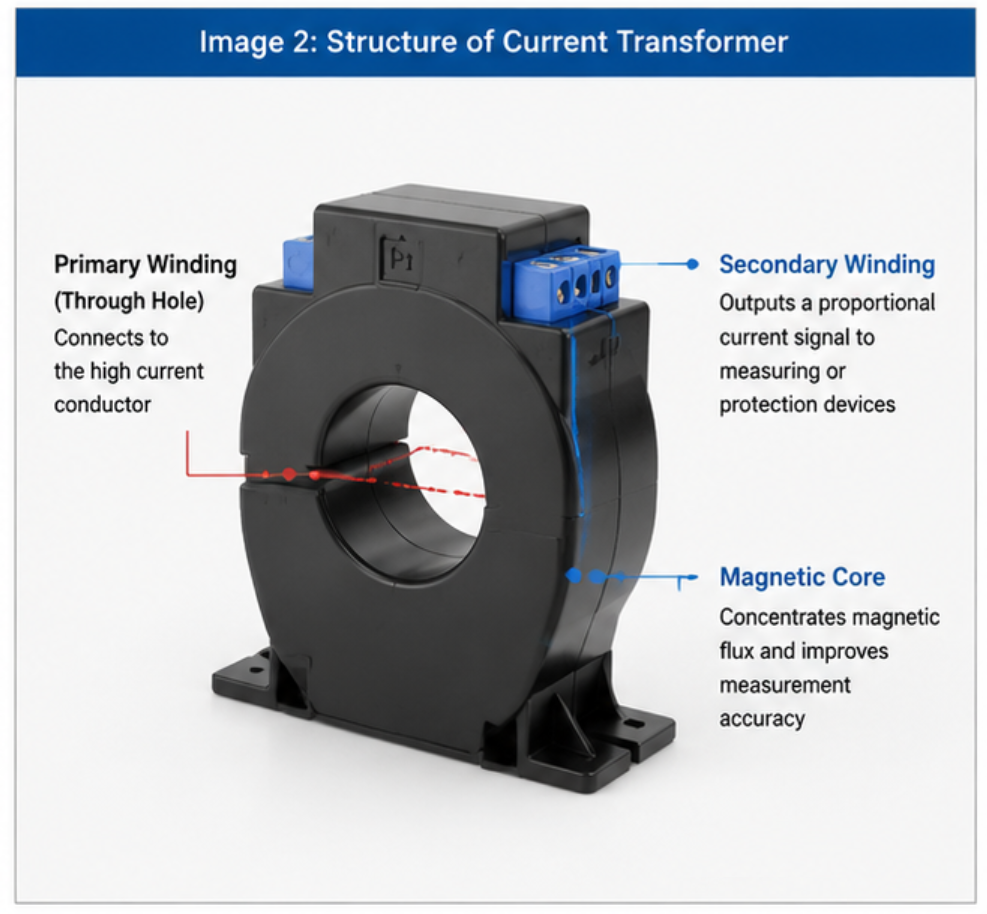
It converts a high current in the primary circuit into a proportional secondary current signal, allowing measuring devices or control systems to safely and accurately monitor electrical current.
Simply speaking:
A current transformer is a device that enables current measurement without directly connecting measurement equipment to high-current circuits.
A typical current transformer consists of:
The primary side is connected to the circuit being measured.
The secondary side provides a proportional output current signal to measuring or monitoring equipment.
The working principle of a current transformer is based on electromagnetic induction.
When alternating current flows through the primary winding, it generates a changing magnetic flux inside the magnetic core.
According to electromagnetic induction principles, the changing magnetic flux induces a current in the secondary winding.
By designing the turns ratio between the primary winding and secondary winding, the current can be converted into a proportional standard output signal.
For example:
A 100A/5A current transformer means:
The measuring equipment can then detect and monitor the high-current system safely through the secondary output.
Based on different structures and application requirements, current transformers can be divided into several types.FERRTX provides different types of Current Transformer Solutions, including toroidal current transformers, split core current transformers, and PCB mount current transformers for various industrial and energy applications.
A toroidal current transformer uses a ring-shaped magnetic core structure.
Main advantages include:
Toroidal CTs are commonly used in:
A split core current transformer uses a separable magnetic core structure, allowing installation without disconnecting the existing cable or circuit.
This design provides several advantages:
Split core CTs are commonly used in:
A PCB mount current transformer is designed for direct installation on printed circuit boards.
Key features include:
Common applications:
With the rapid development of intelligent energy management systems, current transformers have become essential components in many electronic devices and power systems.
Current transformers help systems monitor:
They are widely used in:
Electric vehicle charging equipment requires real-time current monitoring to ensure:
Current transformers provide a reliable current sensing solution for EV charging systems.
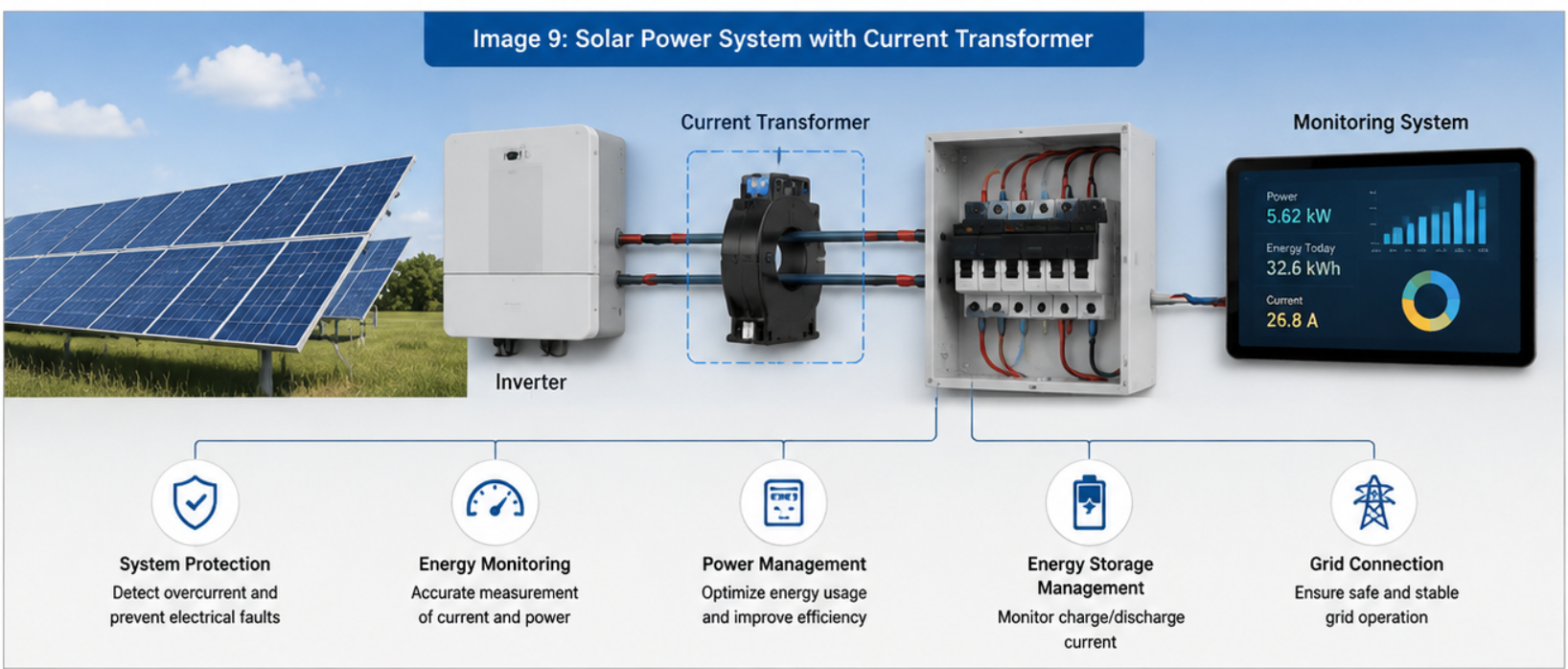
In solar inverters and energy storage systems, current transformers are used for:
They help improve system efficiency and operational reliability.
Industrial automation equipment requires continuous current monitoring to prevent:
Current transformers provide a safe and reliable solution for industrial current measurement.
When selecting a suitable current transformer, engineers usually consider the following factors:
The rated current should match the maximum operating current of the application.
Choosing the correct current rating helps ensure measurement accuracy and reliable operation.
Different applications require different accuracy levels.
For example:
The frequency range of the current transformer should match the target electrical system.
Common power frequency applications include 50Hz and 60Hz systems.
The installation method should be selected according to equipment requirements.
Common options include:
Common CT output types include:
The output should match the requirements of the monitoring or control system.
A current transformer is an important magnetic component that enables safe and accurate current measurement in high-current electrical systems through electromagnetic induction.
From smart meters and energy management systems to industrial equipment and electric vehicle charging systems, CTs play an increasingly important role in modern electrical applications.
Selecting the right current transformer requires careful consideration of rated current, accuracy, installation method, output signal, and application environment.
For equipment manufacturers and engineering teams requiring reliable current sensing solutions, choosing an experienced current transformer manufacturer with strong customization capabilities can help improve product reliability and system performance.


Privacy statement: Your privacy is very important to Us. Our company promises not to disclose your personal information to any external company with out your explicit permission.
Fill in more information so that we can get in touch with you faster
Privacy statement: Your privacy is very important to Us. Our company promises not to disclose your personal information to any external company with out your explicit permission.